Tuesday, June 26, 2018

Willy Wonka: A Comparative Religion Analysis

Last week I had the opportunity to see a children's production of Willy Wonka. I've always found the story interesting and read Roald Dahl's original novel Charlie and the Chocolate Factory (1964) to my sons years ago. The character of Willy Wonka has multiple layers, and in this post I want to analyze him, and by extension the story, through the lens of Comparative Religion.

Gene Wilder famously played the part in the 1971 version of the movie.


Johnny Depp took on the role in 2005, though with much less impact, as I will discuss below.


The story itself is an obvious morality play. The children who tour the faculty are all guilty of some sort of vice of excess. Augustus Gloop is gluttonous, Violet Beauregarde is obsessed with chewing gum, Veruca Salt is materialistic, and Mike Teavee watches too much, well, TV. On the other hand, Charlie Bucket, the impoverished and goodhearted child, is rewarded for his honesty and virtue. In this way, the story is a morality play, much like other famous works, such as Everyman, a Medieval play that espoused good deeds as the only thing that lives on after you die.


Charlie and the Chocolate Factory also has similarities to that towering epic of Medieval poetry, Dante's Divine Comedy. In that work, specifically Inferno, sinners dwell in Hell, embodying their sins with contrapassos, punishments that act out the offense. The Lustful are blown about in violent winds, just as they allowed themselves to be blown around by passions; those who bred Schism and Discord are cut apart by blades, just as they cut apart society; and so on. 


The vice-ridden children are unable to resist temptations in Wonka's factory that lead them to expose their latent flaws. Augustus Gloop, who cannot stop swallowing food, is swallowed up by chocolate.


Violet literally becomes the bubblegum she is chewing.


Only Charlie emerges from the journey unscathed. The fact that the story is a journey from spot to spot in the factory, each with its own lesson to impart, resembles not only Dante's journey through the levels of the tripartite Medieval Christian afterlife, but also some other religious works. In the Buddhist tradition, the Gandavyuha Sutra (just one chapter of the longer Avatamsaka Sutra) describes the disciple Sudhana's journey from teacher to teacher, learning one lesson at a time as he approaches awakening.


Aside from the larger story, the character of Willy Wonka invites even more scrutiny. There is a reason why Gene Wilder succeeds in bringing Wonka to life where Johnny Depp failed: Wonka is both whimsical and sinister. He is a jester-like, trickster-like chastiser of wrongs as much as a rewarder of virtue. He rests on the border of dream and nightmare. Wilder captures this paradox while Depp just comes across as an emotionally-stunted eccentric. A figure that tests and punishes children has to have a touch of madness to him, and even revel in it. To see what I mean, check out how he delights in tormenting his guests during the boat trip scene:


Willy Wonka's costume also communicates his dangerous stature, especially, oddly enough, his trademark hat.


Far from standing for refinement or urbaneness, as one would suppose with a top-hat or bowler hat, such headwear often signifies its opposite, namely the intention to undermine the prevalent social order. Think of Baron Samedi of Vodoun (discussed in an earlier blog).


Or Alex from A Clockwork Orange.


How top- and bowler hats became signifiers for rebellion and madness is not clear, although one promising hypothesis deals with "erethism," a nervous system disorder that can be caused by repeated exposure to mercury. Erethism is sometimes known colloquially as "mad hatter's disease" as those who worked with hats back in the day used mercury to attach the felt.

Wonka is also set apart by his diminutive, orange-skinned, green-haired minions, the Oompa Loompas. They are curious creatures who do not fit into any set classification. They work for Wonka, do his bidding, and take turns announcing the moral failures of each respective child after he or she has been revealed as a glutton, television addict, and so on. 


The Hindu god Shiva, also a category-breaker and challenger of the social status-quo, has a band of small-statured followers (called ganas) who form his entourage.


Mara in Buddhism also has an army of misshapen beasts, primarily seen when he attacks Gautama at Bodh-Gaya. Here they are in a carving on a railing at the Sanchi Stupa in central India.


In at least one instance, Alan Moore's The Killing Joke, the Batman villain the Joker employs tiny, violent creatures to do his evil will, as seen in the excerpt from the comic below.


If you look in the bottom lower right of the image above, you'll see the Joker himself, wearing a purple suit, a hat, and holding a cane. To make the resemblance obvious, here again is Willy Wonka.


What all the foregoing comparisons reveal is that Willy Wonka does not function as a benevolent children's character, but inhabits a space closer to the category-breaking trickster figures of religion and mythology who dish out pain and punishment far more than rewards. He is an embodiment of Victor Turner's concept of "liminality," also called "anti-structure."  Turner used those terms to describe how societies used ritual to move individuals through different life stages. Adolescents, for instance, exist in a liminal (i.e., uncategorized) state of not-child but not-adult, and are thus ritually moved to adulthood by coming of age ceremonies. The psychedelic world of the Chocolate Factory, the Oompa Loompas, and Wonka himself (in dress and behavior) exemplify the uncategorized nature of liminal anti-structure. 

The book and the movie(s) follow Turner's ritual structure. In the beginning, the world is the inverse of what we would hope for: the bad people are prosperous (the "naughty" children) and the good (Charlie and his family) are poor. We enter the Chocolate Factory, the liminal space, and chaos reigns and the usual rules are suspended, allowing for unconventional means to punish vices of excess and affirm virtue, in the form of Charlie Bucket. Leaving Wonka's Factory, the world is now ordered much closer to our moral expectations. Wonka's anti-structure has actually been invoked to defend social structure: Madness has been employed in the service of sanity, and our guide has been Willy Wonka.

Such is my reading of the character and the story. What are your thoughts? Feel free to share.

Until the next time, take care. 

Saturday, June 16, 2018

The Composite Hero

About a year and a half ago, I had the chance to read Steven Rosen's The Jedi in the Lotus, a book about the Hindu symbolism and themes of the Star Wars films. Rosen makes some interesting points in the book and the one I want to concentrate and expand upon in this post is the concept of the "composite hero." The term refers to a group of characters who each strongly exemplify a primary skill or personality trait needed to balance out the others in the group. The members of the group, on their own, are imbalanced or incomplete, but together, they form a unified whole or complete "hero."

The concept of the "composite hero" is a way to think about how narratives like this:


Can be compared to narratives like this:


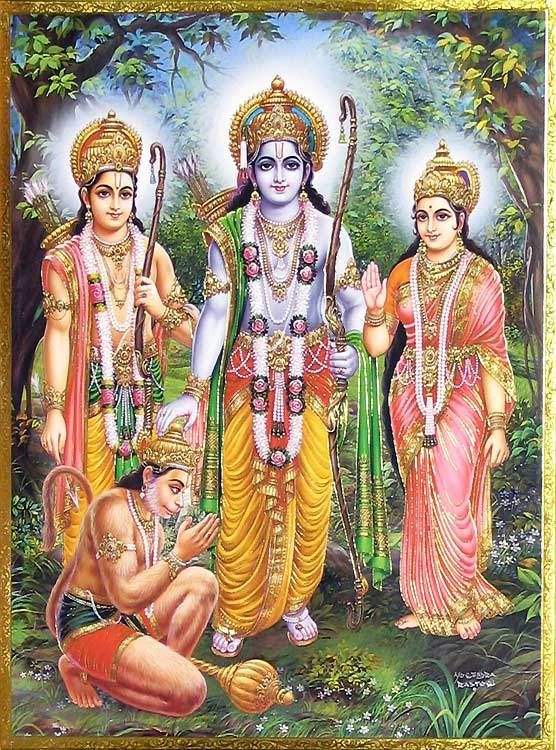
Rosen, probably drawing on the work of famed Ramayana scholar Robert Goldman, notes that in the Indian epic the characters of Rama, his brother Lakshmana, his wife Sita, and his follower Hanuman (pictured above), all complement and complete one another. (For a quick synopsis of the Ramayana, read this link or, better yet, get this book!) Rama is the paradigmatic leader and king, Lakshmana represents brotherly loyalty, Hanuman stands for strength and devotion, and Sita is the exemplar of faithful womanhood. (Sita's portrayal has been seen as problematic and its cultural meaning is, at the least, debatable.)

Rosen compares the interactions of these characters in the epic to the main heroic ensemble of the original Star Wars. Each of those characters also embodies an archetypal ideal: the maverick mercenary (Han), the enthusiastic youth (Luke), the idealist (Leia), the tough guy (Chewie), the wise mentor (Obi-Wan), and the sidekicks (Threepio and Artoo). Each has his/her own strengths, but when they come together, they create something much stronger than the sum of the parts.

The novel Watership Down, which is one of my absolute favorites to have read with Xander, has much the same dynamic.


The book tells the story of a group of rabbits fleeing a disaster and trying to establish a new warren. For those who haven't read it, the book is remarkably erudite and is in many ways a version of the Aeneid, but for kids...and with rabbits. Hazel is a caring, natural leader, Bigwig is tough and resolute, Bluebell provides humor, Dandelion tells stories for the group, Fiver is a kind of prophet and seer, and so on. None of these rabbits would be able to make it as an individual, but by pooling their talents, they are able to survive and create a new home.

A currently popular mythic narrative speaks to the same sense of composite heroics.


As Nick Fury says in the first Avengers (2012): "There was an idea...called the Avengers Initiative. The idea was to bring together a group of remarkable people, to see if they could become something more." Over the course of the Marvel Cinematic Universe, that's exactly what they do: come together to be something greater than they could be on their own.

Certainly there is no shortage of narratives starring a lone hero who, using only his/her own talents and resourcefulness, accomplishes a goal or succeeds in a quest. Those stories emphasize our desire to feel unique and powerful as individuals. The narrative of the composite hero speaks to a different need: the need to feel like part of a team, as an accepted member of a community. Paradoxically, in these narratives, the characters only find out how talented they are as individulas by discovering how much they need other people. Their uniqueness emerges primarily when they work together with those who contribute very different things.

It may be a stretch, but I wonder if the narrative of the composite hero will become even more popular in times where we experience more and more social alienation. Going back to our roots as a species, we most likely lived in small groups of hunter-gatherers who all contributed, each in their own way, to the survival of the community. In a vastly more aggregated, industrialized society, it can be difficult to see how one's contributions help the greater whole or how one truly stands out in a teeming, faceless crowd. 

We all want to know that we matter and that we have something to offer. The myth of the composite hero offers a very basic, human truth about how to discover what that is: we truly find ourselves in our relationships to other people.

That's all for now. Until the next time, take care.


Tuesday, May 29, 2018

Religion and Music

The last of the anniversary vote-getters is the topic of this post: Religion and Music. Music has always had a central role in religious practice. The earliest worship scriptures we have (namely the 1500 BCE Vedic writings from South Asia) are hymns. In other words, they are songs. Prior to that, certain ancient Mesopotamian writings make clear the role of music in reaching out to the deities they worshiped. There are those who argue that music is inherently religious, while others argue that music created religion, or vice versa. That's a debate for another time  - it's clear the two have long been interrelated, and will continue to be.

What I want to do here is look at some of the ways religious ideas have been employed in popular music from the last few decades, particularly in songs that (for one reason or another) I have personally found compelling. There are prominent examples I won't do much with, like Kanye West's "Jesus Walks" or Joan Osborne's "What if God was One of Us?" not because they're bad songs, but they just never really spoke to me.

The first example, for both the song and its video, is Madonna's (controversial) "Like a Prayer" from 1989. The video is below and the lyrics are here.


While some saw the song and video as blending the sacred with the profane and showing how sexuality could be sacred (even comparing it to the Biblical Song of Songs), others saw the video and its use of Christian imagery as blasphemous, including the pope at the time, John Paul II.

In other cases, songs use religious imagery or ideas to critique society. One such example, also from the late 1980s, is Motley Crue's "Wild Side." Supposedly, bassist and lead songwriter Nikki Sixx wrote the song as a twisting and inversion of the Lord's Prayer to describe life on the pitiless streets of Los Angeles. Read the lyrics and see for yourself.


Some bands employ religious imagery over and over in their songs, like U2. We could talk about "Pride (In the Name of Love)," "Mysterious Ways, " "If God will Send His Angels," for Christian imagery or, I would argue, "Beautiful Day" or "Walk On" for Zen Buddhist inspirations. However, I have always enjoyed one of the band's lesser known and rougher-edged tunes: "The Fly." Off Achtung Baby, the song was conceived of as a message sent from a demon or a trickster figure suffering in Hell. Read the lyrics and take a listen.


I enjoy everything about the song, from how the distorted guitars match the distorted thoughts, to the switch between high-voiced choruses and snarling verses, to the soaring guitar solo. The greatest part, though, is the philosophical: the singer ("the Fly" persona) offers many compelling and persuasive aphorisms, but he is, after all, a denizen of Hell. Is he being insightful and offering sincere advice, or is this just another attempt at deceit? I used to think of the song every time I taught Othello in Core 4, since that combination of insight and deceit perfectly summarizes Iago. Whichever it is, we get some of my favorite lyrics of all time about the experience of writing or any other kind of creative endeavor: "Every artist is a cannibal / Every poet is a thief / All kill their inspiration / And sing about the grief." 

One final example evokes, in both its ebullience and its lyrics, the sentiment with which we started: music itself is a kind of religion as it gives rise to spiritual, transcendent feelings. This is the song "Ever Tear Drop is a Waterfall" by Coldplay. Read the lyrics and take a listen.


The song talks about how the beat of the music melds with the narrator's pulse, puts "Heaven in sight" and lights up the "Cathedrals in my heart." That's a beautiful image for how music and religion connect with one another, not to mention our own vitality. Beyond that, I've always found this song to be particularly inspirational. Whenever I'm down, I like to think I'm only "in the gap between the two trapeze" -- whatever it is, it's just a blip and I'll catch hold in a minute. In addition, I love the mind-blowing Zen-like quality of saying that "Every siren is a symphony / And every tear's a waterfall."

Religious experience is often defined as "ecstatic," which derives from Greek literally as "standing outside oneself." If you've ever been to your favorite band's concert and felt part of something bigger than yourself as the crowd cheers, or just been compelled to dance at home alone to a catchy song, can't we say that's being pulled "outside oneself"? Whenever we do, we enact what humans have known since the beginning: music and religion go together.

What are your favorite songs that deal with religious topics, images, or themes? What music gives you a transcendent feeling? Feel free to comment to this blog or at Facebook. Until the next time, take care.
Wednesday, May 23, 2018

Black Panther: the Poison of Anger and the Need for Justice

As has happened in the past, a topic has captured my interest to supersede my regularly scheduled blogging subject. (Don't worry, "Religion and Music" will have its day.)

This past week I (finally) had the chance to see Black Panther, the story of a superhero from the fictional African nation of Wakanda, and it was as epic as everyone has been saying. This is a tale of truly mythic proportions, all with a resonating social conscience. There is a great deal I think this movie can teach us about how festering anger, even righteous anger, can destroy the good along with the bad. Simultaneously, it points out the need to recognize the egregious mistakes committed in the name of "tradition." These points are primarily carried out in the contrast between T'Challa (a.k.a "Black Panther") and N'Jadaka ("Killmonger"), which evokes (to me, at least) nothing less than the grand complexity of the Indian epic Mahabharata.


Before we get to that, though, there are a couple of other items worthy of note in this film. (Be careful if you haven't seen it yet, because I may give away spoilers.)

First, in what may be an unpopular statement, Black Panther's portrayal of its female characters vastly surpasses what you find in other superhero films, up to and including Wonder Woman.


From the elite warriors of the Dora Milaje (led by the fierce Okoye), to the scientist Shuri, to Queen Ramonda, to the resourceful Nakia, these are rich, multifaceted, self-determined people who are actually the ones to put things back together at a crucial moment when all seems broken. Having just re-watched Wonder Woman recently, the female characters in Black Panther seem far more multidimensional, and thus more empowering.

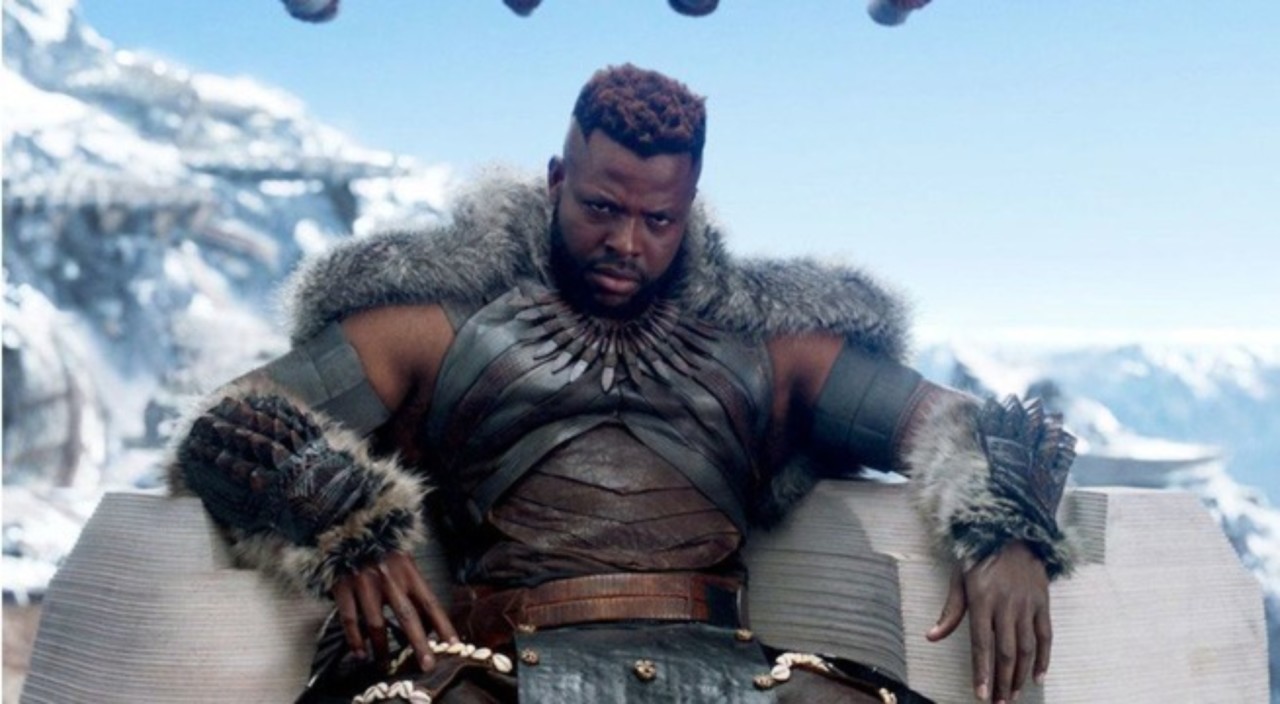
Second, I was rather taken aback to hear the character M'Baku ("Man-Ape" in the comics) say "Glory to Hanuman" prior to a ritual fight.


Hanuman is an Indian religious figure, not African. I wonder why the filmmakers would select Hanuman as the patron of the Jabari ape clan when there were ape figures in African mythology, such as A'ani of Egypt or Ghekre of the Baule in the Ivory Coast. Whatever the reason, they found it necessary to censor the use of Hanuman's name for distribution in India.

Third, as I blogged about a while back, there is a complicated relationship between fathers and sons, and Black Panther expertly delves into that territory. This isn't anything new for the Marvel Cinematic Universe (or obviously the comics, for that matter). A recurrent aspect of the Thor movies is the hero coming to terms with Odin's expectations, and failures. Tony Stark also deals with father issues, as shown in Iron Man 2 and Captain America: Civil War. That the Marvel Cinematic Universe has taken the care to create a multi-generational narrative is impressive, and something that (as I have noted before) puts it in touch with other world mythologies.

As I  mentioned above, one myth that Black Panther powerfully resembles is the Hindu Mahabharata, specifically how the past histories and antagonism between the characters Karna and Arjuna parallel N'Jadaka and T'Challa. In Mahabharata, the young woman Kunti becomes pregnant -- via an incantation -- with the sun god Surya's child. Fearing what will become of her and the child since she is not married, Kunti abandons the baby, who grows up to be Karna. Later, Kunti marries Pandu, who allows her to use the incantation again, giving birth to five other sons, one of whom is Arjuna, fathered by the god Indra. Arjuna grows up in royal splendor as a celebrated figure in the warrior class. Karna is also a worthy warrior, but given the ignorance of his parentage, he is denied the respect and honors that are his right. He grows up resenting and hating the Pandavas, especially Arjuna, and when the war for the right to rule the kingdom begins, Karna sides with the Pandavas' deadly enemies. The enmity between Karna and Arjuna builds to a fever pitch until, in the last days of the war (and in an act that is not his most honorable), Arjuna kills Karna while the latter's chariot wheel is stuck in the mud.


Karna is an unquestionably tragic figure. He is filled with rage because his life was ruined by forces outside of his control. He was treated unfairly all his life, first by his mother, then the impersonal constraints of hereditary social class, then by his own half-brothers.

N'Jadaka, the antagonist in Black Panther, has just as much reason to be angry. He can also easily be interpreted as a tragic figure.


After his father was killed by T'Challa's father, N'Jadaka was left to grow up amid American poverty, discrimination, and institutionalized racism. During this time, his anger (toward global oppression, T'Challa's father, T'Challa himself, and Wakanda in general) only festers and intensifies. He learns combat skills and becomes a lethal, remorseless murderer nicknamed "Killmonger," all as part of a plot to return to Wakanda and exact vengeance on all who've wronged him. Killmonger is entirely justified in his anger, but his plan (to spread Wakanda's weapons across the world and spark dozens of insurrections and wars) would only metastasize his pain throughout the globe, not to mention reproduce the problematic colonialist policy he decries.

T'Challa faces his own issues with anger and vengeance, but to a degree he has conquered some of those inner demons after hunting down his father's killer in Captain America: Civil War. You can see his transformation in the clip below.


Even with this character growth, Killmonger at first proves to be more powerful, overthrowing and nearly killing T'Challa. While he hovers between life and death, T'Challa encounters his father and his other ancestors. Now, knowing that his father killed N'Jadaka's father and abandoned the young boy to poverty and discrimination in America, just as Wakanda has abandoned the world through its isolationism, T'Challa comes to an epiphany you can watch in the clip below.


This epiphany restores T'Challa strength, physically as well as morally. Prior to that, he had been an apologist for his father and the Wakandan way, but now he recognizes all of their omissions, shortcomings, and crimes. Though T'Challa and N'Jadaka have not had their rematch yet, this scene decides the outcome for it inverts the relationship between the characters. Previously, N'Jadaka possessed the greater moral claim due to the wrongs he suffered and T'Challa's refusal to acknowledge them. However, N'Jadaka forfeits that claim by following a destructive path equivalent to the name "Killmonger." He has allowed his anger to make him cruel, vindictive, and oblivious to how he has become just like those he hates. On the other hand, when T'Challa shows the willingness to question and challenge his own society's assumptions and criticize it where it must rightly be criticized, he truly becomes "Black Panther" again and regains the moral high ground.

Black Panther has much to teach us about how to deal with injustice. N'Jadaka is completely justified in his outrage, but by myopically seeking vengeance, he loses himself to the identity of Killmonger. To paraphrase my colleague Rob Reuter, holding onto to anger is like drinking poison and expecting it to hurt someone else. Clinging to rage only corrodes your soul and turns you into that which you despise.

At the same time, it is naive and unreasonable to expect those who've been wronged to "just get over it." In Mahabharata, Kunti reaches out to Karna and entreats him to join his brothers and simply forget all of the wrongs done to him. Karna refuses, and I don't blame him: without Kunti acknowledging the impact of her actions or the Pandavas questioning their hereditary privilege, what reason does Karna have to join them? In contrast, after defeating Killmonger, T'Challa takes him to see his first Wakandan sunset, something he'd dreamed of as a child left in America.


T'Challa then offers to heal him so that he live the rest of his days in Wakanda. To me, these gestures are far more meaningful than Kunti's, as T'Challa honestly acknowledges Killmonger's grievances. This also makes T'Challa a more appealing character than Arjuna, who never shows Karna any sort of mercy. In the Bhagavad Gita Arjuna does question his society's warrior orthodoxy in the way T'Challa questions the ways of his Wakandan ancestors. However, Arjuna's concerns are ultimately satisfied and he reverts to his prior perspective. T'Challa is forever changed and sets about reforming his society. Killmonger, on the other hand, cannot bring himself to change. He is not capable of responding to T'Challa's offer. Anger has consumed him and he lets himself die rather than contemplate any other way of living.

That part of the film haunts me. What if Killmonger had chosen instead to transcend his anger, go with T'Challa, and embrace his heritage as N'Jadaka? What could the two of them have built together? What could we do if we all acknowledge our anger, admit to our injustices, and then rebuild as one? What would that be like? If Killmonger had just let go of his anger and hate, they could have built a new Wakanda together. Now, all they have is a sunset.

That's all for now. Until the next time, take care.

Tuesday, May 15, 2018

This Blog Will Eat Your Brain! (Or, the Mythology of Zombies)

Holding true to my promise, the topic for this post is the second-highest vote recipient of the anniversary election: Zombies!


The image above is from George Romero's film Night of the Living Dead (1968), one of the very first zombie movies ever made. Admittedly, the zombie has never been one of my favorite monsters to think about or study. They've only emerged to wander lethargically through my imagination quite recently, and due entirely to my sons' discovery of a certain computer game.


They seemed so taken with the muttering, shuffling, vacant-eyed creatures that I started to wonder what all the fuss was about. Zombies have certainly become famous, from World War Z to The Walking Dead to Zombie Apocalypse games and speculations. But what exactly is a "zombie" and where does the figure come from?

At root, a zombie is a reanimated corpse. In world mythology, the Egyptian god Osiris, killed by his brother Set and revived by his wife Isis, is an ancient example of a figure coming back from the dead. He is never quite the same, though, and is only able to live in the underworld, where he serves as its ruler.


In Celtic Irish myth, there is a creature called a marbh bheo, which is a human come back to life, but only for a select period of time, such as samhain (what we call "Halloween," the New Year's Eve of the Celtic calendar). The marbh bheo could eat, drink, dance, and even exact revenge for grievances experienced during life. But they could not speak, lest they divulge the secrets of what lies beyond death.

The region most associated with the Zombie myth, though, is the Caribbean, particularly Haiti and the greatly misunderstood religion of Vodun (sometimes called "Voodoo"). Put briefly, Vodun arose from the mix of West African traditions, Catholicism, and the brutality of the slave experience in the Caribbean. Vibrant rituals and personal connections to figures in a wide pantheon of gods (called loa) characterize Vodun. (As an aside, I have always found Baron Samedi to be one of the more intriguing loas. Perhaps the picture below will give some indication as to why.)


He has some interesting similarities to the Hindu god Shiva, and perhaps one day I will blog about those comparisons.

Anyways, amid the complexities of Vodun, legends grew of how bokor (priest-figures) could use their own powers or draw on the powers of the loa to transform the recently dead (or the still living) into mindless servants. In that way, the slave-master dynamic is acted out once more, but to the advantage of those historically oppressed. Some thoughtful pieces have been dedicated to sorting out this sad, forgotten part of the zombie myth.

Could there be such a thing as an actual zombie? To answer that question, we must come to terms with the fascinating story of Clairvius Narcisse, potentially a real life "zombie." Clairvius was thought to have died in Haiti in the early 1960s from a mysterious illness. His family buried him and that, supposedly, was that. One day in 1980, however, he wandered into his sister's village, dazed and confused. Over time, his memory returned to him and he recounted being given a strange powder by a bokor. He claimed that his "death" was really just a kind of coma and the bokor and others later exhumed him from the grave and shuffled him between employers as a field laborer for almost two decades. The whole time, Clairvius said, he was given more of the powder, which kept him in a foggy, hazy, and compliant mental state. Only when the powder wore off could he escape.

Could it be true? If so, what might be in the mysterious powder? Wade Davis, a Harvard-trained ethnobotanist, has long argued that the answer lies not in magic or religion, but neuro-toxicology. Davis suggests that the zombie myth, especially as it appears in Haiti, can be explained by a toxin (called "tetrodotoxin") present in certain plants and some fish. When harvested from these sources and administered at a sub-lethal dose, the toxin impairs metabolism and the parts of the brain that govern speech and willpower. Hence, you get a shuffling, mumbling, compliant servant - in other words, a zombie.

Both the story of Clairvius Narcisse and the findings of Wade Davis are controversial. Putting aside the question of whether zombies are "real" or not, we are still left with the question of why they are seemingly everywhere now in popular culture.  Whether it's terrifying zombies (like 28 Days Later) or silly zombies (Shaun of the Dead), the figure has certainly evolved, but its prominence appears to be growing.  Why?

In the wonderful phrase coined by scholar Judith Halberstam, "Monsters are meaning machines." In other words, monsters are closely connected to the times they represent, expressing the particular thoughts, fears, anxieties, animosities, and so forth of the period in which they appear. A perfect example is Bram Stoker's novel Dracula, which is a tapestry of Victorian England's repressed tumult over issues of class, race, and gender. Similarly, the original Japanese movie Godzilla (1954) is a poignant and visceral treatment of the horrors of atomic warfare. What do zombies embody that make them a meaningful monster for the current cultural moment?

The most persuasive argument I uncovered in the course of researching this blog is that zombies represent total societal and moral breakdown. They are a marauding, speechless, senseless, irrational, random force that threatens to consume you and turn you into one of them. A time of failing economies, environmental devastation, and perpetual war and strife is a moment when the threats to civilization are global and dispersed rather than specific. In that situation, the zombie, a monster that symbolizes the utter breakdown of civilization, would be popular.

That's all for the zombie, for now. Next time, I tackle the third highest vote recipient: religion and music. Until then, take care.

Wednesday, May 2, 2018

Real-Life Monsters

Today marks the one year anniversary of my very first blog. Happy birthday, Forest Dweller Thoughts! It's been an interesting year, quite unlike any other in my life and the blog has served as creative and personal catharsis many times over. Thank you to everyone who's been reading it. I appreciate being able to bend your ear from time to time.

There will be a little more retrospective at the end. First though, as followers of my affiliated Facebook page know, I held a contest to decide the topic of this anniversary post. The top vote-getter: "Real-Life Monsters." So, you wanted it, here you go!

As former students will recall, the study of monsters has figured prominently in my academic research. Over the last twenty years, a group of interdisciplinary scholars have developed something called "monster theory," which purports to analyzes myths and stories of monsters from around the globe. In a class once, I asked what people thought the key ingredient was for being a monster. "Scary," was the answer. The academic study of monsters tries to delve down into what accounts for that. Some of the cross-cultural characteristics of monstrosity include deformity, anthropophagy ("eating people") or violence, representing the wilderness, and association with the night. All of these things break fundamental social or psychological categories. Monsters scare us because they represent breaks in what we consider to be the natural order of the community or the world.

What one defines as the "natural order" thus determines what is a monster, so monstrosity can be relative, making it an interesting point of cultural comparison. Examples that I've dealt with in my various courses have included the likes of Greek mythic beasts, Ravana from Hinduism, Bram Stoker's "Dracula," Lovecraft's "Cthulhu," and, the subject of my forthcoming book, the Buddhist god/demon Mara. In the blog, I've written about other kinds of beasts, like the Hodag of Wisconsin and the religious imagery of the Mothman of Point Pleasant, West Virginia. All of these beings are fictional, though. Are there biological organisms that actually fit the "monster paradigm"? What are the most physically impressive/unusual (which sounds better than "deformed"), violent, or wild? What organisms most challenge our current natural or mental categories?

There were clearly such creatures in the planet's past. There was the South American arctotherium, a bear that weighed two tons and stood eleven feet tall, and the shastasaurus, a marine predator sixty-five feet long. This is in addition to the usual speculation about the largest carnivorous dinosaurs. But what about the creatures of today? What animals have the right combination of unsettling abilities or habits to label them "monsters"?

One that comes to mind is the Komodo dragon.


As the article linked above describes, this is the heaviest lizard on earth. They're ten feet long weigh at least three hundred pounds. They dart quickly at their prey and bite with serrated teeth while their venom glands release a potent toxin into the victim's flesh. Rather than wrestle the prey down, the Komodo then steps back and lets the venom do its work. The toxin contains an anti-coagulant and a sedative, so the prey tries to escape, but slowly falls into shock. Komodos have been known to patiently follow their prey, often for miles, ghoulishly waiting until it collapses.

Komodos don't really attack humans, but the same cannot be said for the Botfly.


The Botfly makes its living by laying its eggs on a mammalian host. The body heat causes the eggs to hatch into maggots, which burrow into the host's flesh to feed. They pupate within the host, then drop out to the ground to continue their life-cycle as mature flies. Yes, this can happen to humans and, as argued by Matt Kaplan in Medusa's Gaze and Vampire's Bite: the Science of Monsters, such real-life parasites may have inspired a very popular fictional monster, the "xenomorph" (literally, "strange form") of the Aliens movies.


Moving out into the ocean, researchers have only just recently confirmed the existence of two massive species of squid. There is the giant squid (architeuthis), which is found in every ocean of the world.


This species can be as much as thirty feet in length. In the seas of the Antarctic, though, lurks the mesonychoteuthis, the "colossal squid," which grows to be more than forty feet in length and possesses the largest eyes ever recorded in the animal kingdom at sixteen inches in diameter. (That's about as big as a beach ball.)


While the giant squid has suction cups on its tentacles, the colossal squid has razor-sharp hooks. Don't get into a tickle fight with one of these things!


This is a place where myth and science meet, as the concept of a gigantic cephalopod roaming the oceans first took the form of the monstrous kraken, known from Greek myths and also literary works such as Jules Verne's 20,000 Leagues Under the Sea. If a mythic monster like the Kraken could be proven real, who knows what else exists out there?

In case you were wondering, I passed up discussion of creatures like the python and the great white shark since they are already fairly well known, and the actual human deaths caused by these creatures are in the single digits annually. Do you know what organism is responsible for the most human deaths each year?


Through transmission of disease, the tiny mosquito reliably kills about three quarters of a million people around the world every year.

The fact that a little insect can wreak that much havoc tells us something about what it means to be a monster. The point of monsters is not their size or their violence, but really their attachment to the unknown. The word "monster" comes from the Latin monstrare, "to reveal." A "monster" is literally a "revelation," a de-monstration of what we do not yet understand. Each of the creatures I picked to talk about somehow represents the unknown, and it is the unknown, more than anything else, that truly frightens us.

And it was being thrust into the unknown that initially inspired me to go on this blogging journey. It's been a great journey this past year. The freedom to write what I want and make the connections my mind wants to make has really reinvigorated my love of writing. Based solely on the number of views, some topics did not resonate much (like World Wars, children's books, and philosophical perspective), which is fine because I still enjoyed writing them. In other cases, I was pleasantly surprised by the popularity of some posts. Ones about John Taylor Gatto and Wendell Berry, the sport of archery  and turkeys captured a fair amount of attention. The post opposing the Beaver Lake CAFO garnered a whole other level of attention, but the most viewed post was still Ghosts, about my time working with the Phoenix Team in Drexel Hall.

So, what will year two bring? Zombies, for one, since that was the second highest vote recipient. At times there will be more of the same, with comparisons of myth and popular culture, but all I can really guarantee is unpredictability. As I wrote in my very first post, the title for this blog (the "Forest Dweller") is someone who has left behind old, comfortable trappings to explore what is new. One thing I have learned over the past year is that we are always engaged in that process, whether we know it or not.

Writing these posts has been a fun journey. Thanks for coming with me. Until next time, take care.

Thursday, April 5, 2018

Life is Pain

Due to a chronic health condition, I've been thinking a lot about pain lately. Particularly, about how to deal with pain, about what persistent pain does to the body and the mind, about how it colonizes your thoughts and has you continually looking over your shoulder awaiting its onset or return. The First Noble Truth of the Buddha states (in the Pali language) sarvam dukkham - "All is pain." Some have translated this to mean, "Life is suffering," but I prefer the more literal translation that "all is pain." As a non sequitur, I was really surprised to see this line appear in the movie The Princess Bride. If you don't believe me, here's the clip:


Anyways, the Buddha argued that pain is the great leveler of human experience: there is no person who will avoid sickness, aging, and death. Seeing firsthand the pervasiveness of such pain, as depicted in the temple mural below, is supposedly what drove Siddhartha Gautama to undertake the spiritual journey that led him to become the Buddha.


Of course, there are those who endure far more than others, who are wracked with constant pain and disability throughout life, to the point where they are veritably imprisoned in a damaged cage of a body. What would it be like to be trapped in a physical form consisting of unremitting pain or, alternatively, one that is robbed of sensation, that has lost the ability to respond to one's commands? Not long ago, we lost Stephen Hawking, who endured the ravages of Lou Gehrig's Disease to produce brilliant insights into the workings of the universe. A few years back, I watched the film version of his life, The Theory of Everything. In the heartbreaking scene below, he fantasizes about performing the simplest action -- picking up a pen -- that is beyond his broken body, yet in the midst of that thought, delivers


Is that the key to living with pain - "However bad life may seem, there is always something you can do and succeed at." Certainly there are many examples of those who've overcome pain or disability to achieve great things. Think of Helen Keller, Ray Charles, Stevie Wonder, or someone like Christopher Reeve, who brought prominence and dignity to the issue of spinal paralysis. In the following clip from several years ago, he connects with a fan who has also suffered paralysis.


Years ago, while teaching a course on science and the human condition, we read an article about Brooke Hopkins, a retired English professor from the University of Utah who broke his neck while mountain biking. Discussing the daily mechanical interventions needed to prolong his life and reading the descriptions of the constant physical torment he endures, I could not escape the recurrent, shameful thought, "thank goodness I'm not him."

But as Reeve points out in the clip, that is false comfort. As the Buddha saw, life is pain. Infirmity, illness, and death are the great predators that inevitably catch us all. We are all one freak accident or unexpected illness away from a changed life.

So, what's to be done? I am not sure, but my mind goes back to something I saw about two months ago. My wife and I stayed at a Bed and Breakfast in Valparaiso where you could birdwatch through beautiful picture windows and listen to the bird songs via microphones. There was a little bird we saw with a deformed, diseased eye. It could not fly as high or as fast as the other birds. Surely it would be preyed upon or dead by the next day, we thought. The next morning, though, it was back. And both days, it sang. Singing is an instinctive, territorial response in most birds, so this was not an expression of happiness or pleasure, as many people sometimes take it. But, despite its pain and disability, the bird kept on doing what it was driven to do. Could I be that strong? Hawking and Reeve and others have been able to push on and do remarkable things despite the traumas they suffered. They, as perhaps we all should aspire to, "sang" in their own ways and in the face of a life that is pain.

Monday, February 26, 2018

Lost Worlds

Visions of vanished worlds have been on my mind for a couple of months now. While visiting Jasper Junction with my wife, I came across a secondhand copy of the book The Atlas of Legendary Places. (This was just one extraordinary find. Besides that, there were two action figures from the Inhumanoids toyline and two boxes of Tetley tea. Who takes Tetley tea to a secondhand store? Who buys Tetley tea from a secondhand store? The answer to the last question at least is clear: we do!)

Anyways, the book find was serendipitous as I have been considering writing something about vanished worlds, but not necessarily real worlds that have disappeared. Instead, I am fascinated by tales of lost worlds that never were, realms like Atlantis, Eden, and Camelot. Sure enough, the book had entries on each of these places. One common link between each of these locations (and some others I'm leaving out due to space constraints) is how they are evoked, either metaphorically or seriously, to make sense of experiences of tragedy and loss. There is already a great book on the subject (i.e. the "politics of nostalgia"), so in this post I mainly want to touch on how each of these three fictional lands has been used to construct visions of the "good old days." At the end, if you hang in there, I have included a special announcement.

Atlantis

According to the myth, Atlantis was once the most advanced and cultured civilization on earth, but it grew decadent, warlike, and complacent, leading to a cataclysmic punishment: earthquakes and tidal waves destroyed the entire island, entombing it beneath the waves forever. This story originates most likely with the Greek philosopher Plato, who used Atlantis as a metaphor for how societies can go wrong. Generations of later thinkers and explorers wondered if he was referring to an actual place possessed of untold riches. Hence began the speculation as the "real" location of the lost world.  For some, like Helena Blavatsky (a Russian Spiritualist/Medium/Psychic/Purveyor-of-all-things-weird), Atlantis was a real place that represented humanity's lost greatness. Blavatsky believed she was in psychic communication with departed residents of Atlantis and hoped to use their wisdom (among others, like the "Ascended Tibetan Masters" and representatives of Martian civilization) to point humanity out of its 19th century military-industrialist doldrums.

Eden


The Garden of Eden story is actually the second of two different creation stories in the Hebrew Bible's Genesis. (This alone should convince people that Biblical literalism is untenable, but, what are you going to do?) Believe it or not, like Atlantis, people have been looking for an actual location for this fictional spot for some time. (Check out this list - especially the first one.) While the Biblical story certainly has roots in Mesopotamian folklore, there are scholars who believe its pastoral setting is due to its context: it may well have been written during a period of increased urbanization, when nostalgia for green, idyllic places was high. In his attempt to create a Christian epic on par with the Iliad and Odyssey, John Milton used the Eden story in Paradise Lost to question the British monarchy and suggest it had gone astray from earlier, better foundations.

Camelot


Arguably, one of the more prominent "lost worlds" referred to in American culture is Arthurian Camelot, the paragon of just rule and chivalry. Like Atlantis and Eden, Camelot came to an end through inner corruption, but the wonder of what it was for a brief, shining moment echoed on. This initially Welsh myth, which again has been a persistent focus of investigation, came to be equated with the Kennedy presidency, partly because of a prominent Broadway musical on the subject that ran during the period, but also due to the shock of Kennedy's tragic assassination, the abruptness of which resembled the end of Camelot -- or Atlantis and Eden, for that matter.

Myths of long lost lands of placid peace obviously fill a human need for security, for dealing with painful transitions and passages in our own day-to-day lives. They are a way to articulate, through narrative, the odd feeling that "good times" only exist in the past. For instance, take this oft-shared meme from the show The Office:


There is something haunting about this realization, which I am sure many of us have felt. Times change, circumstances shift, and comfort zones we have built up either retract or disappear. At those moments, what came before can feel like a paradise compared to the anxiety of not knowing what's coming. In those times, we relate to the residents of Atlantis, Eden, and Camelot - they too, we feel, lost something precious and golden to the fog of uncertainty.

However, these feelings can obscure something else that's equally true: almost nothing in life is completely perfect. There's a line in an old Billy Joel song: "The good old days weren't always good / and tomorrow ain't as bad as it seems." (Check out the song, if you're curious.)

Or, for a more contemporary iteration of the same sentiment, there's Macklemore and Kesha, "Good Old Days."


Some of the best lines come at the end:

"Never thought we'd get old, maybe we're still young
May we always look back and think it was better than it was
Maybe these are the moments
Maybe I've been missing what it's about
Been scared of the future, thinking about the past
While missing out on now."


Pining over lost Atlantises, or Edens, or Camelots is wasted energy. Even in the stories, there were things drastically wrong in each of those settings that contributed to their demise. For each of these paradises, the "good old days" were not entirely good, and the same is true for all of us, except in times of strain and stress, there is a real temptation to feel that way. In that case, I've resolved to remember, at least for myself, that the good old days were good, but we need to make tomorrow better.

And Now for the Big Announcement:
A couple of weeks ago I received word that my book manuscript (Malleable Mara: the Transformations of a Buddhist Symbol of Evil) has been accepted for publication by the State University of New York Press! This is a great press for studies of Buddhist and Hindu traditions. In one form or another -- through an MA thesis, a PhD dissertation, and then an actual book -- I have been working on this manuscript since about 2002, so this is the culmination of a lot of toil, self-doubt, and perseverance. For those curious, the book is about how the mythical figure "Mara" in Buddhism has been portrayed differently according to changing times, religious rivalries, cultural contexts, and even popular culture. Here is an artistic representation of Mara attempting to stop Siddhartha from becoming the Buddha:


(Mara's the green guy on the elephant.)

More to come as the book gets closer to release, but for now, I could not wait to share the news! Until the next post, take care.

Thursday, February 15, 2018

Fathers and Sons

First, in between now and my last blog on archery, I came across a fascinating article on how the sport is played in Bhutan and the ways in which it brings people together. Imagine trying to hit a target from 460 feet!

The topic for this post stems from our family's most recent homeschooling unit dealing with civil rights and African-American history. Besides reading about Martin Luther King, the horrifying period after Reconstruction, and seeing a great musical on the 1961 Freedom Riders, we read the novel Sounder by William Armstrong. When I was in second grade, our teacher, Mr. Leichty, read the book to us and I was very taken by it, imagining what it would be like to be the boy in the story. Encountering it again, I was drawn to the character of the father, most likely because I am now a father myself, showing how time and life changes alter our perceptions of stories. Sounder also resonated with a book I read not too long ago: Cormac McCarthy's The Road, which also tells the tale of a relationship between a father and son during desperate times. In this post I'm going to compare the two stories and their remarkable similarities, especially looking at what they have to tell us about the complex ways fathers and sons perceive one another. (There will be times, necessarily, when I give away parts of each book, so keep that in mind. Obviously, if you've read both books, this post will mean more to you, but if you haven't, maybe by the end you'll want to.) Also, if you stay with me to the end, there is a bonus Haiku!


Sounder (1969) focuses on an African-American sharecropping family. Amid the poverty and racial oppression they face, the oldest boy and his father find joy in hunting with their hound named "Sounder" due to his booming bark. (Interestingly, the dog Sounder is the only named character in the entire book.) During a particularly bleak winter, as the family goes hungry day after day, the father goes out in the night to steal food so that they can eat. Not long after, the white sheriff and his deputies arrive to arrest the father in a disturbing scene that involves Sounder being badly wounded with a shotgun blast. Convinced the dog could still be alive, the boy searches for Sounder, who eventually returns, though mutilated and mute. The boy then undertakes long journeys looking for his father at various prison labor camps, encountering abuse and violence from whites along the way. Though he never finds his father, he does meet a teacher who offers to tutor him in reading and writing. Eventually, the father returns home, crippled by his years of hard labor in prison. He, and Sounder, die shortly thereafter and the boy moves on to continue his education.


The Road (2006) is not for the faint of heart. It is as stark and bleak as the cover above suggests. The same is true for the 2009 film adaptation starring Viggo Mortensen.


The Road describes a shattered, post-apocalyptic world of ash and cinders. An unnamed father and son travel through this devastated, desolate landscape, making their way to an undefined destination, with only each other for comfort. McCarthy reflects the spareness of the landscape in the text itself by eliding apostrophes, commas, quotation marks, and even capital letters. The words themselves have been rendered barren, just like the earth. As the man and boy travel, they face starvation and must be constantly vigilant against roving bands of ruthless cannibals. Though they speak of being "the good guys" and want to keep a spark of humanity ("the fire") burning, the father's uncompromising protection of his son often veers into unwarranted suspicion and even cruelty toward strangers. The boy picks up on this and fears they may be turning into "the bad guys." Sickness and a wound from a hostile band eventually lead to the father's death, but the boy is able to find a family of people he can trust and with whom he can carry on.

Both books share the device of not naming their characters. At one point, select critics found fault with Sounder for this move. Framing the characters in this way, though, lends both texts a kind of universality: they are not about particular people, they are about tensions, pains, and issues anyone can face. These books also refuse to provide firm places or dates, rendering the location of the narrative both nowhere and everywhere (though in fairness, given its firmer historical context, we could probably loosely locate Sounder). These choices on the part of the authors help to pull the reader in and see beyond particularities to the broader resonance of human experience.

Both books also delve into religious imagery. Sounder offers explicit instances where the boy and his mother refer to David and Goliath or Joseph in Egypt as touchstones for their current situations. I think it's significant that the Biblical references are entirely to the Old Testament, with that corpus' themes of escaping slavery, dealing with a wrathful (and usually inscrutable) God, and the pining for justice. The Road offers far less evident notions of religious imagery, but when more diffuse concepts arise, they are quite powerful. For instance, as the father looks at his sleeping son, he thinks, "If he is not the word of God God never spoke." This simple line potently communicates the father's fierce devotion, as well as the burden he feels. There are possible references to Job and Revelations in the book, and some have argued that the boy symbolizes a kind of Christ-child. I find this kind of interpretation much less convincing than the tack that the book wrestles with base human conflicts about what it means to be a good, moral person, and all the potential religious questions such a tension abuts.

Most poignant for me, however, is the register both stories hit regarding the journeys fathers take with their sons. (One certainly could read either text for the even more universal theme of parenthood, but as a father with sons, that is the level at which I was struck.) Both fathers struggle, but are ultimately unable, to protect their sons from a thoroughly hostile world. Both fathers are pushed over the moral line (one by stealing, the other by lying) in the effort to provide for their boys. The father in The Road is especially flawed, consistently acting in ways that bend or break the very morality he is trying to instill in his boy. Yet, what sets him apart from the surroundings is that he is at least attempting to provide a good example whereas the rest of world has given up. Finally, both fathers die when their sons are fairly young, yet, in acts of authorial mercy, Armstrong and McCarthy end their stories with each boy finding paths to seemingly brighter future, whether (respectively) through education or a surrogate family.

When my wife and I first became parents, I keenly felt the descent of heavy responsibility onto my shoulders and perceived, more than ever before, that the world around me did not correspond to the world I wanted for them. The books encapsulate what I fear and hope for my own sons. I fear how I will never be able to fully protect them, that hurts and trials unknown and unfair await them. I hope, even as it pains me, that like the boys in both stories, they will be able to move beyond my need to protect them. In Sounder, we can see that the boy has moved on when, after his father dies, he realizes Sounder will soon follow, but is willing to still leave to attend school, even though the dog is still living. He has let that part of his life go in order to create his future. In The Road, the boy could stay hidden where his dying father secluded them, but instead he ventures out and discovers another (friendly) family. I could not help but read the dire straits of both books as the fears we fathers have for our sons of what they will encounter when we're gone, but the endings gave me hope enough to trust that, though our boys must journey on ultimately without us, they will find their way. The last words of the father in The Road evoke a courageous faith in life that I am not certain I share, but to which I aspire: "Goodness will find the little boy. It always has. It will again." In Sounder, the first book the boy finds is from Montaigne and at the end of the story, after his father's death, he recalls this famous quote: "Only the unwise think that what has changed is dead." It is a sign that the boy will carry forward his father's influence, remembering the man when he was in his prime. Those images, I suppose, live on in our children's minds, just as images of them as our little ones live on in ours.

Bonus Haiku
While shoveling snow the other day, I thought up a haiku:
                           
                                                White flakes fall gently
                                                 on the earth. The call of a
                                                 hawk breaks the still air.


That's all for now. Until the next time, take care.

The Only Good Mosquito...?

         The coming of Spring and Summer for many Americans means the reinstatement of a hallowed cultural past-time: lawn maintenance. Comp...

Most Popular Posts of the Past Month